Learning to recognize shapes is an important part of early childhood math education. With 2D shapes cut and paste worksheets, children can explore basic geometric shapes through hands-on activities that combine visual recognition, sorting, matching, and fine motor practice. Instead of simply looking at shapes on a page, students actively identify, cut, organize, and glue them into the correct places.
These activities are especially useful for preschool, pre-kindergarten, and kindergarten students who are beginning to recognize circles, squares, triangles, rectangles, and other common two-dimensional shapes. They also provide opportunities for children to compare objects, notice geometric properties, and explain their choices.
Whether used in a classroom math center, a small-group lesson, or a homeschool activity, shape cut and paste worksheets can make early geometry practice more engaging and accessible.
What Are 2D Shapes Cut and Paste Worksheets?
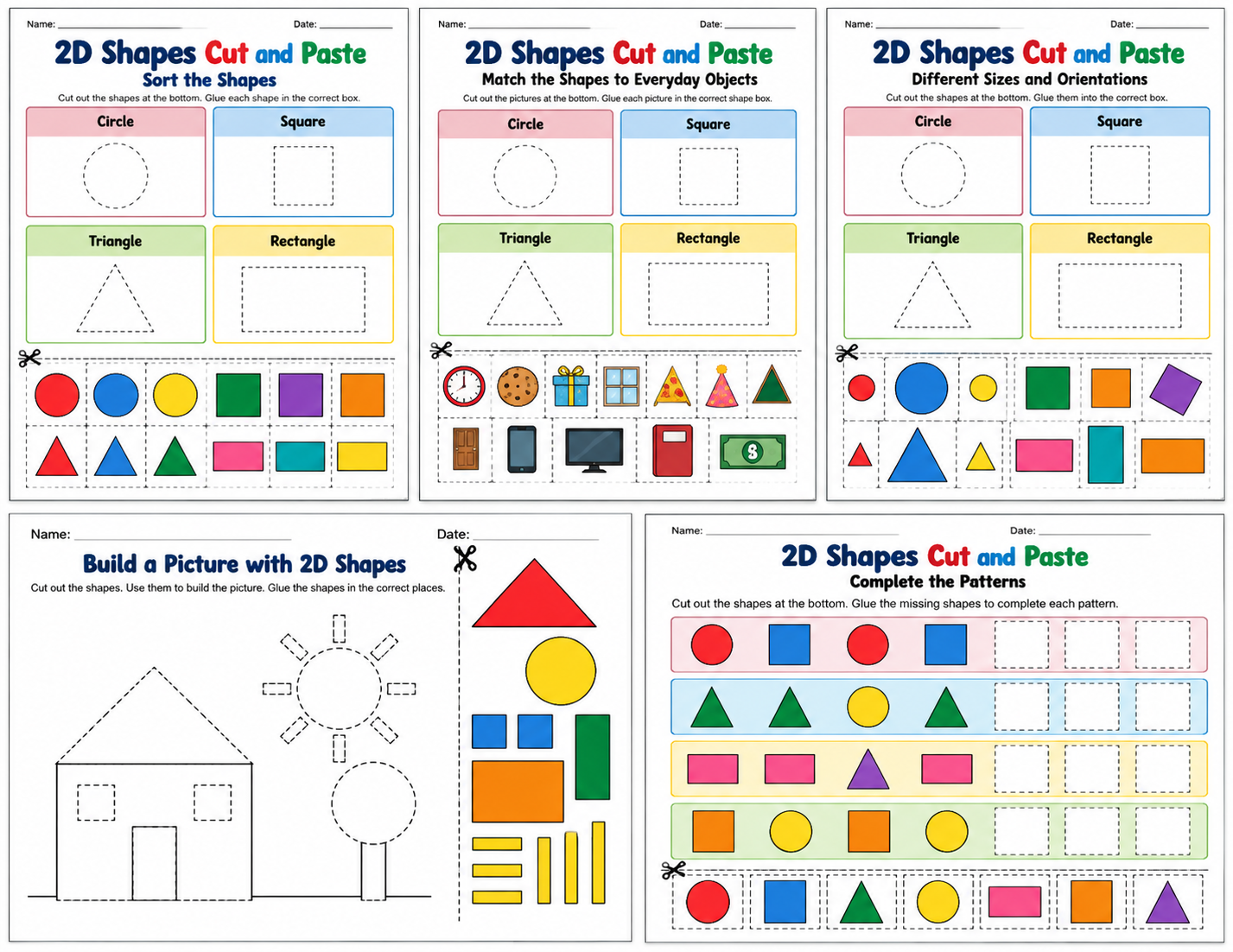
2D shapes cut and paste worksheets are printable learning activities in which children cut out geometric shapes or pictures and glue them into matching spaces, categories, or patterns. The activities focus on two-dimensional figures, which have length and width but no measurable thickness as geometric figures.
A typical worksheet might display several labeled boxes and a collection of shapes at the bottom of the page. Children identify each shape, cut it out, and place it in the corresponding box. Other activities ask students to match shapes with everyday objects or sort figures according to their characteristics.
These worksheets combine several early learning skills:
- Shape recognition: Identifying common geometric figures by appearance and properties.
- Visual discrimination: Noticing differences between similar shapes.
- Classification: Grouping shapes according to shared characteristics.
- Spatial awareness: Understanding how shapes fit, rotate, and relate to one another.
- Fine motor coordination: Practicing controlled cutting, positioning, and gluing.
Because students interact physically with the materials, teachers can observe both mathematical understanding and developing scissor skills during the same activity.
Common 2D Shapes Children Can Learn
Early geometry instruction usually begins with a small group of familiar shapes. Once children can recognize these figures confidently, they can explore additional shapes and compare their properties.
Circle
A circle is a round shape with a continuous curved boundary and no corners. Children can identify circles in clocks, wheels, coins, and other familiar objects. A cut and paste activity might ask students to separate circles from shapes with straight sides.
Square
A square has four equal sides and four right angles. Students can practice recognizing squares in different sizes, colors, and orientations. Rotating a square helps children understand that its identity does not change when its position changes.
Triangle
A triangle has three straight sides and three corners. Triangles can look different depending on their side lengths and angles. Activities that include several types of triangles help students avoid assuming that every triangle must look exactly the same.
Rectangle
A rectangle has four sides and four right angles, with opposite sides equal in length. A square is also a special type of rectangle. Young children can begin by identifying familiar rectangular shapes, such as doors, books, and picture frames, before exploring this relationship.
Oval
An oval is a familiar early-learning term for an elongated, rounded shape. Children can compare oval and circular outlines to notice differences in their appearance. Eggs, balloons, and some mirrors provide useful visual examples, although real objects do not always match geometric outlines perfectly.
Additional Shapes
Students who are ready for more challenging activities can explore pentagons, hexagons, rhombuses, and other polygons. These figures introduce new opportunities to count sides, compare corners, and classify shapes by their geometric properties.
Types of 2D Shapes Cut and Paste Activities
Shape worksheets can support different learning objectives depending on how the cutting and pasting tasks are organized. The following activities are suitable for early geometry practice.
1. Shape Matching Worksheets
In a shape matching activity, students cut out individual shapes and glue them onto corresponding outlines. The worksheet may include circles, squares, triangles, and rectangles in different colors or sizes.
For beginners, use clearly separated outlines and matching shapes of similar sizes. More advanced learners can match shapes that have been rotated or resized, encouraging them to focus on geometric characteristics rather than exact visual appearance.
2. Shape Sorting Worksheets
Shape sorting worksheets ask children to classify several shapes into labeled groups. For example, a page might contain four boxes labeled Circle, Square, Triangle, and Rectangle.
Students cut out the figures and place each one in the correct category. This format encourages careful observation and allows teachers to assess whether students recognize shapes independently.
To increase the challenge, include different colors and orientations within each category so children learn that a shape’s identity is not determined by its color or position.
3. Shapes in Everyday Objects
Connecting geometric shapes with familiar objects helps children understand how geometry appears in daily life. A worksheet can feature pictures of wheels, windows, signs, clocks, and other objects.
Students cut out the pictures and match them with the corresponding geometric shapes. Encourage them to explain their choices by describing the outlines they notice.
Some objects contain several shapes, so select illustrations with clear target features when introducing this activity.
4. Build a Picture With Shapes
Shape-building worksheets combine geometry with creativity. Children cut out circles, triangles, squares, and rectangles, then arrange them to create a recognizable picture.
For example, a house can be assembled from a square or rectangle and a triangular roof. A simple vehicle might use a rectangular body and circular wheels.
Students can identify the shapes they used after completing their pictures. This encourages mathematical vocabulary while giving children opportunities to experiment with spatial arrangements.
5. Shape Pattern Worksheets
Pattern activities introduce students to repeating sequences using geometric figures. A worksheet might display a circle-square-circle-square sequence with missing spaces.
Children select the correct shapes, cut them out, and glue them into the empty positions. Begin with simple AB patterns before introducing ABC or AAB sequences.
Although pattern recognition extends beyond geometry, using shapes as pattern elements reinforces visual identification and comparison skills.
How to Use Shape Cut and Paste Worksheets
A successful activity begins with clear instructions and materials that match children’s developmental abilities. Teachers and parents can follow these steps to make shape practice productive.
- Introduce the shapes. Show examples of the figures featured on the worksheet. Say each shape’s name and discuss visible characteristics, such as straight sides, curves, and corners.
- Demonstrate the task. Complete one example together so children understand where the cutout belongs and how to attach it.
- Identify before cutting. Ask students to point to or name the shapes before using scissors. This separates recognition difficulties from cutting difficulties.
- Cut out the pieces. Provide age-appropriate scissors and supervise children as needed. Students who are still learning to cut may benefit from larger pieces or adult-prepared cutouts.
- Sort and check. Encourage children to place all pieces in their intended positions before applying glue.
- Glue and discuss. Once the pieces are attached, review the completed activity and ask children to explain how they identified each shape.
Children do not need to complete every worksheet independently. Some learners benefit from guided practice, while others may be ready to work with minimal assistance.
Download 2D Shapes Cut and Paste Worksheets
Free Printable 2D Shapes Cut and Paste Worksheets
Explore five fun, hands-on activities for learning 2D shapes.
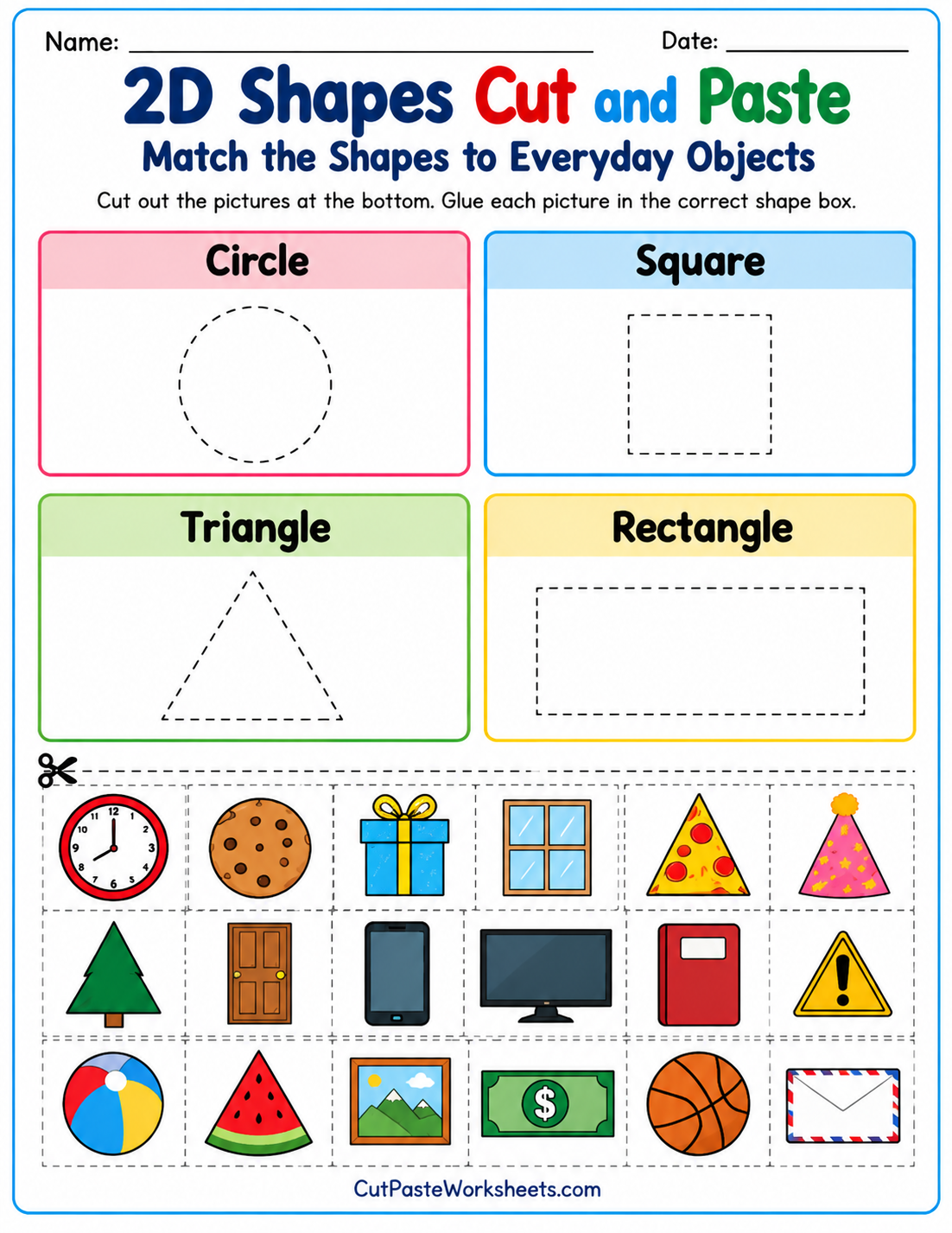
Sort the Shapes
↓ Download Worksheet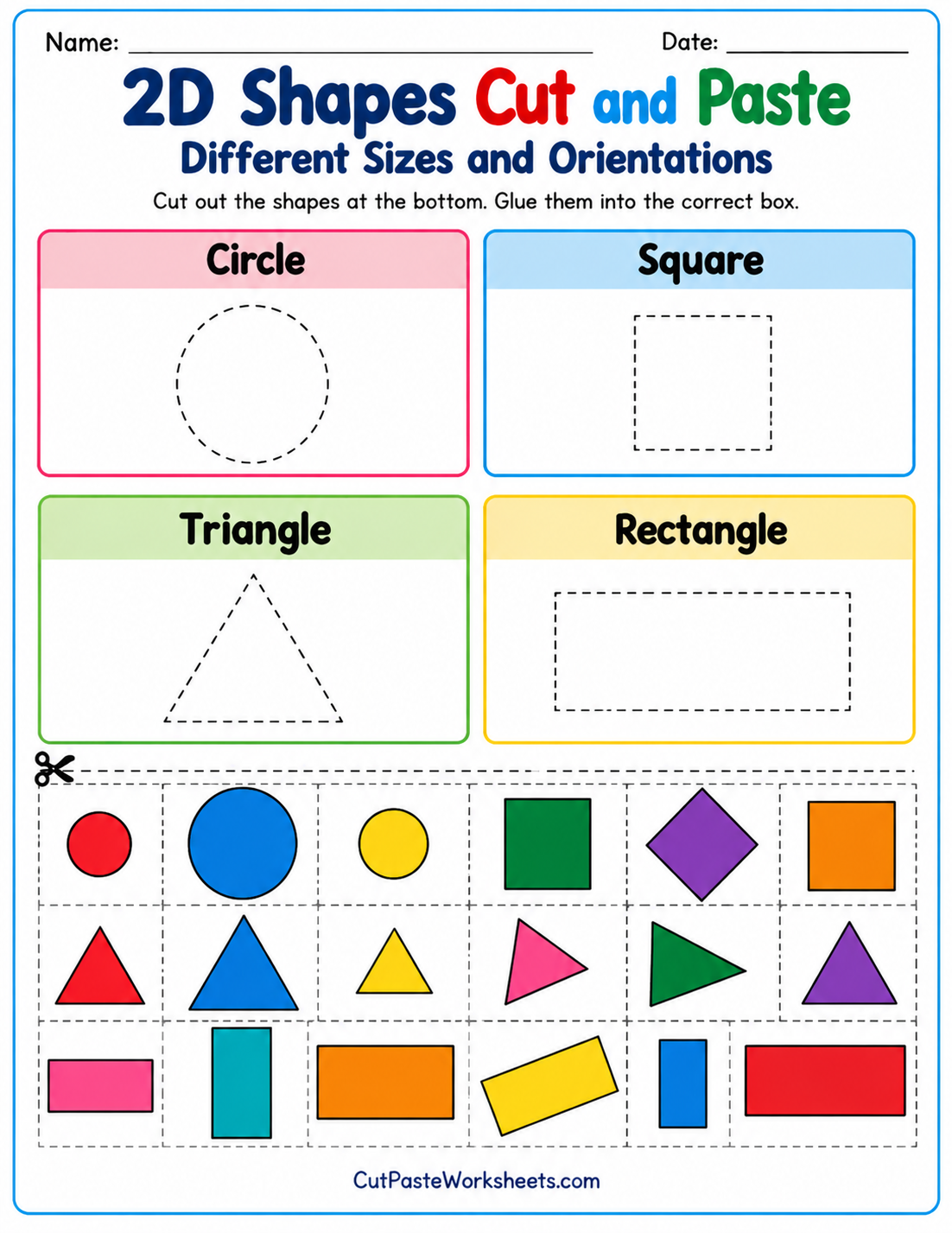
Everyday Objects
↓ Download Worksheet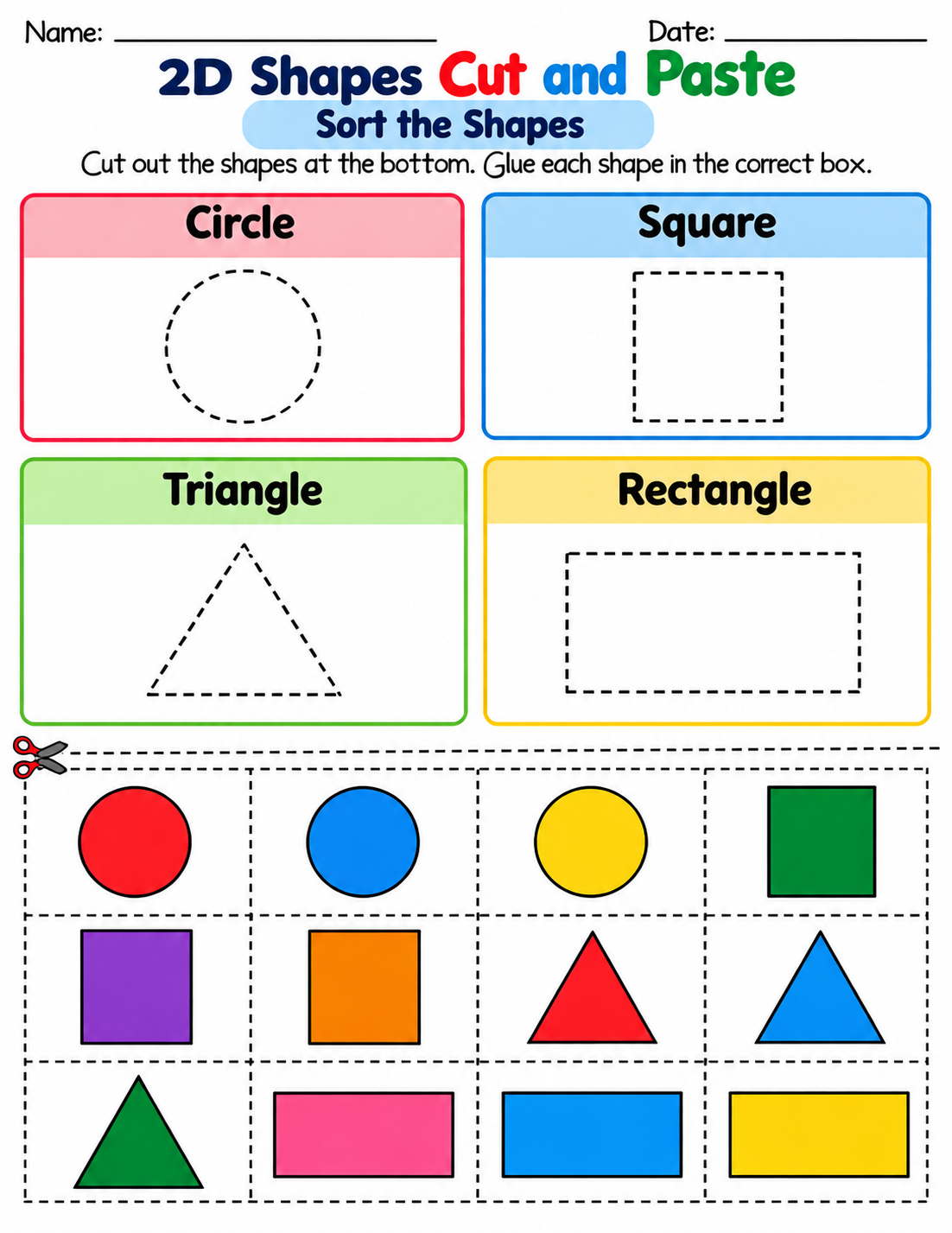
Sizes and Orientations
↓ Download Worksheet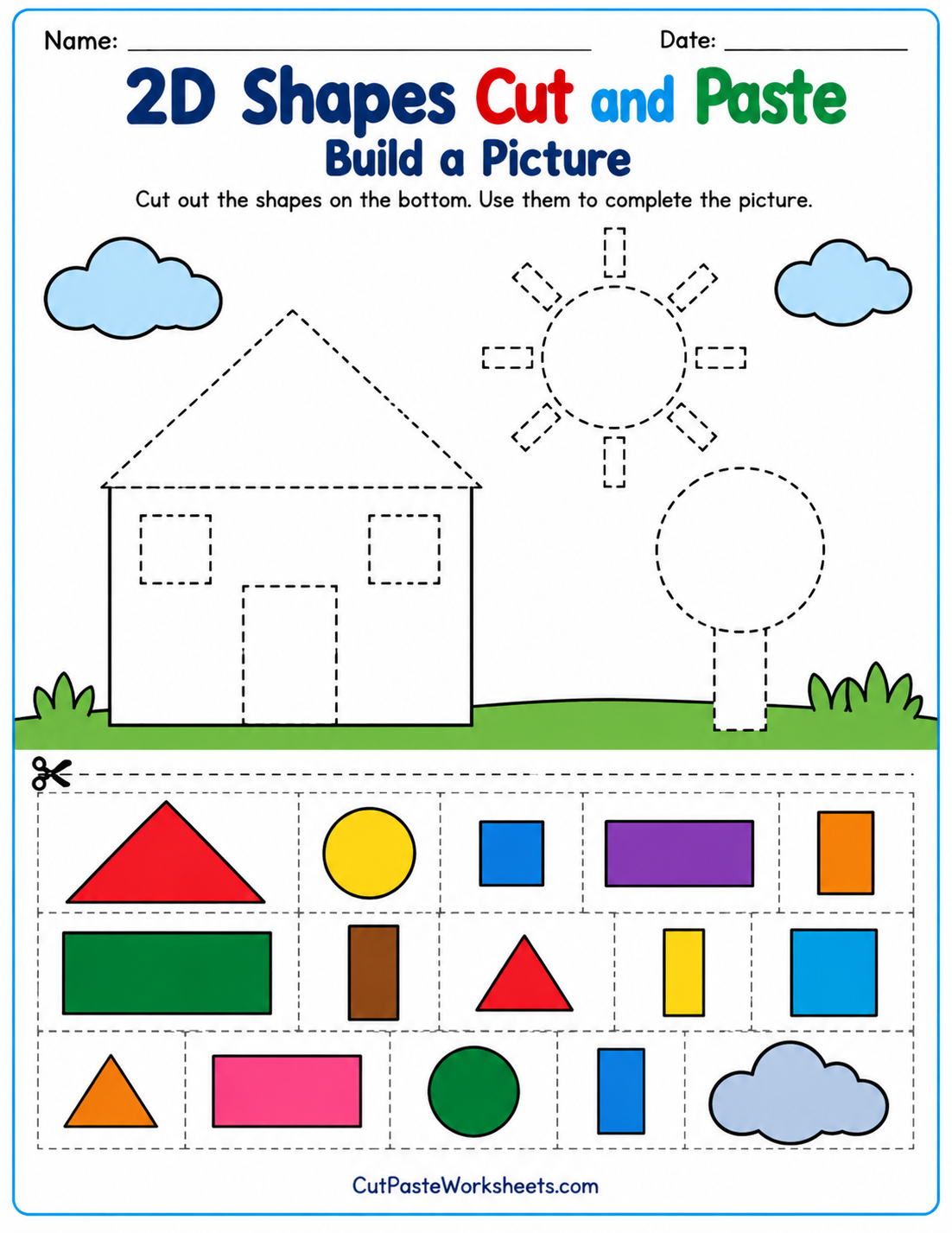
Build a Picture
↓ Download Worksheet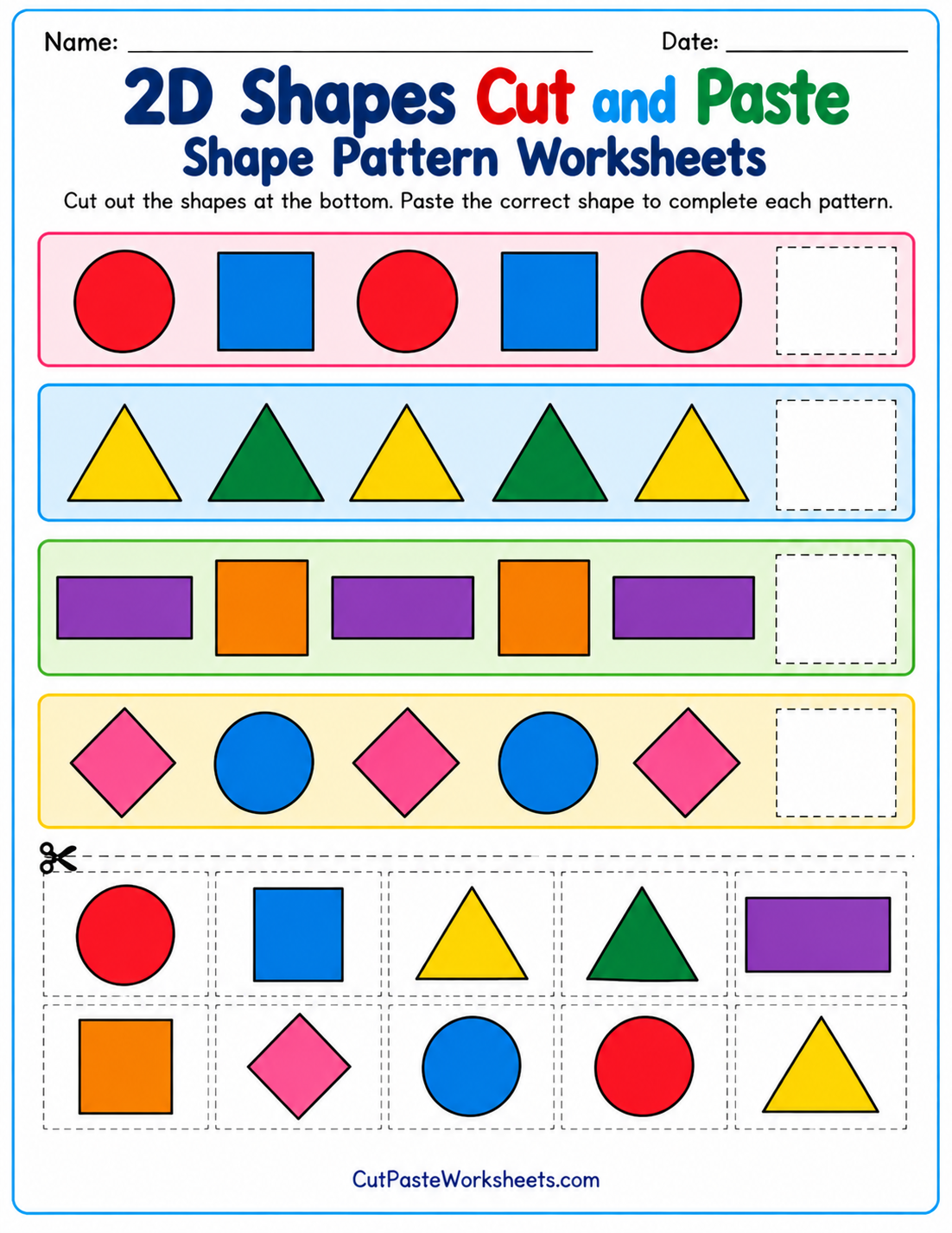
Shape Patterns
↓ Download WorksheetShape Activities by Grade Level
Preschool
Preschool students generally benefit from activities featuring a few highly recognizable shapes, such as circles, squares, and triangles. Large cutouts, simple matching tasks, and minimal visual distractions help keep the focus on recognition.
At this stage, children may identify shapes by appearance before they can describe their mathematical properties. Naming, pointing, and matching are useful starting activities.
Pre-Kindergarten
Pre-K students can begin sorting shapes into multiple categories and comparing their characteristics. Worksheets may introduce rectangles, ovals, and different orientations of familiar figures.
Encourage children to describe what they notice. Questions such as “How many corners does this shape have?” or “Are these sides straight or curved?” promote mathematical reasoning.
Kindergarten
Kindergarten students can explore shapes in greater detail, including counting sides and corners, identifying figures regardless of orientation, and composing larger pictures from smaller shapes.
Some learners may also be ready to compare squares and rectangles or recognize additional polygons. Activities should emphasize understanding rather than memorizing a single visual example of each shape.
Tips for Teaching 2D Shapes Effectively
Children develop stronger geometric understanding when they encounter shapes in varied contexts. Instead of relying on one worksheet format, combine printable practice with discussion, observation, and hands-on exploration.
- Vary the examples: Show shapes in different colors, sizes, and orientations.
- Discuss properties: Encourage students to notice sides, corners, and curved boundaries.
- Use everyday objects: Invite children to find familiar shapes around the classroom or home.
- Provide cutting support: Use larger pieces or precut materials when fine motor demands interfere with the math objective.
- Ask open-ended questions: Invite students to explain why a figure belongs in a particular category.
- Review misconceptions: Show that a rotated square remains a square and that triangles can have different appearances.
It is also helpful to distinguish between recognizing a shape and cutting it accurately. A child may understand the geometry but still need support with scissors. Assess these skills separately when necessary.
Frequently Asked Questions
What shapes should preschoolers learn first?
Circles, squares, and triangles are useful starting points because they have distinctive visual features. Rectangles can be introduced as children become comfortable recognizing and comparing basic shapes.
Are cut and paste shape worksheets suitable for kindergarten?
Yes. Kindergarten students can use them to identify shapes, sort figures, compare properties, complete patterns, and build pictures. The difficulty can be adjusted by changing the number and variety of shapes.
How can I make shape worksheets easier for beginners?
Use fewer shapes, larger cutouts, clear outlines, and simple instructions. Children who find cutting difficult can work with precut pieces while concentrating on shape identification.
How can I make shape activities more challenging?
Include rotated shapes, unfamiliar examples, multiple sizes, and figures with similar characteristics. Ask students to explain their classifications using words such as sides, corners, straight, and curved.
Do shape cut and paste activities help develop fine motor skills?
They provide opportunities to practice scissor control, hand-eye coordination, positioning, and gluing. However, the amount of support needed varies, and mathematical understanding should not be judged solely by cutting accuracy.
Explore More Math Cut and Paste Activities
Recognizing two-dimensional shapes is one part of early mathematics. Children can continue developing foundational skills through counting activities, number matching, simple addition, subtraction, and pattern practice.
Combining shape activities with other hands-on math experiences gives students opportunities to observe, compare, classify, and solve problems in different ways. With appropriately challenging tasks and supportive instruction, cut and paste worksheets can become a practical part of early geometry learning.