Learning to count is one of the first important math skills children develop during preschool and kindergarten. While counting aloud is a helpful starting point, young learners also need opportunities to connect numbers with real quantities. Counting cut and paste worksheets make this process more interactive by combining number recognition, object counting, and hands-on activities.
Our free printable counting cut and paste worksheets help children practice numbers from 1 to 10 through colorful illustrations and simple cutting and pasting exercises. Instead of only writing answers, children count objects, find matching numbers or dot cards, and glue them into the correct spaces.
These activities are suitable for preschoolers, kindergarten students, homeschooling families, and early elementary classrooms. Each worksheet is designed to make counting practice engaging while supporting fine motor development.
Free Printable Counting Cut and Paste Worksheets
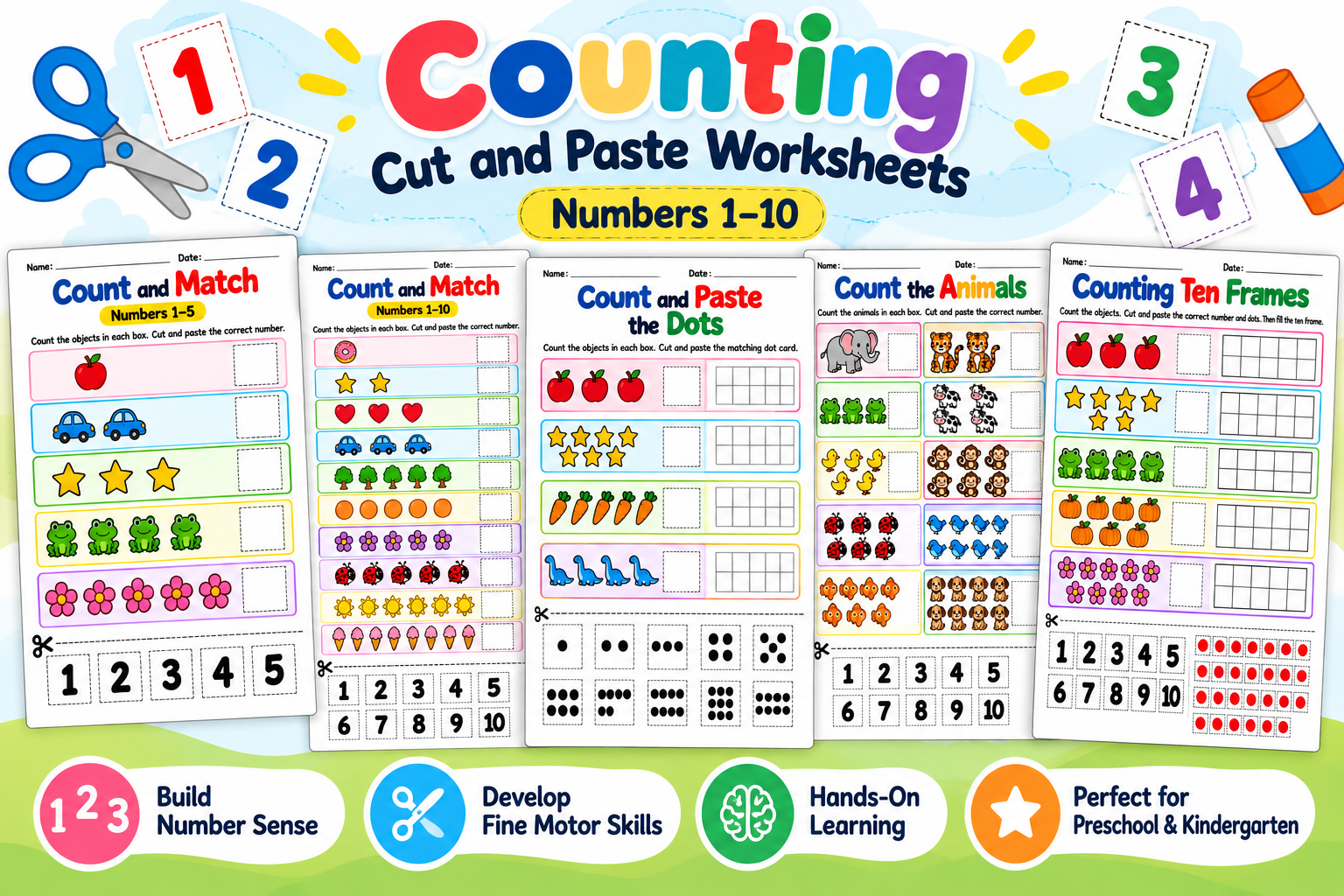
This collection includes five different counting activities. Each printable focuses on an important early math skill, from recognizing small quantities to understanding ten frames.
You can download each counting cut and paste worksheets individually or get the complete collection as a printable PDF.
Free Printable Counting Cut and Paste Worksheets
Explore five fun counting activities for preschool and kindergarten. Preview each worksheet and download your favorites.
Count and Match Numbers 1–5
Count groups of objects and paste the correct numbers from 1 to 5.
↓ Download Worksheet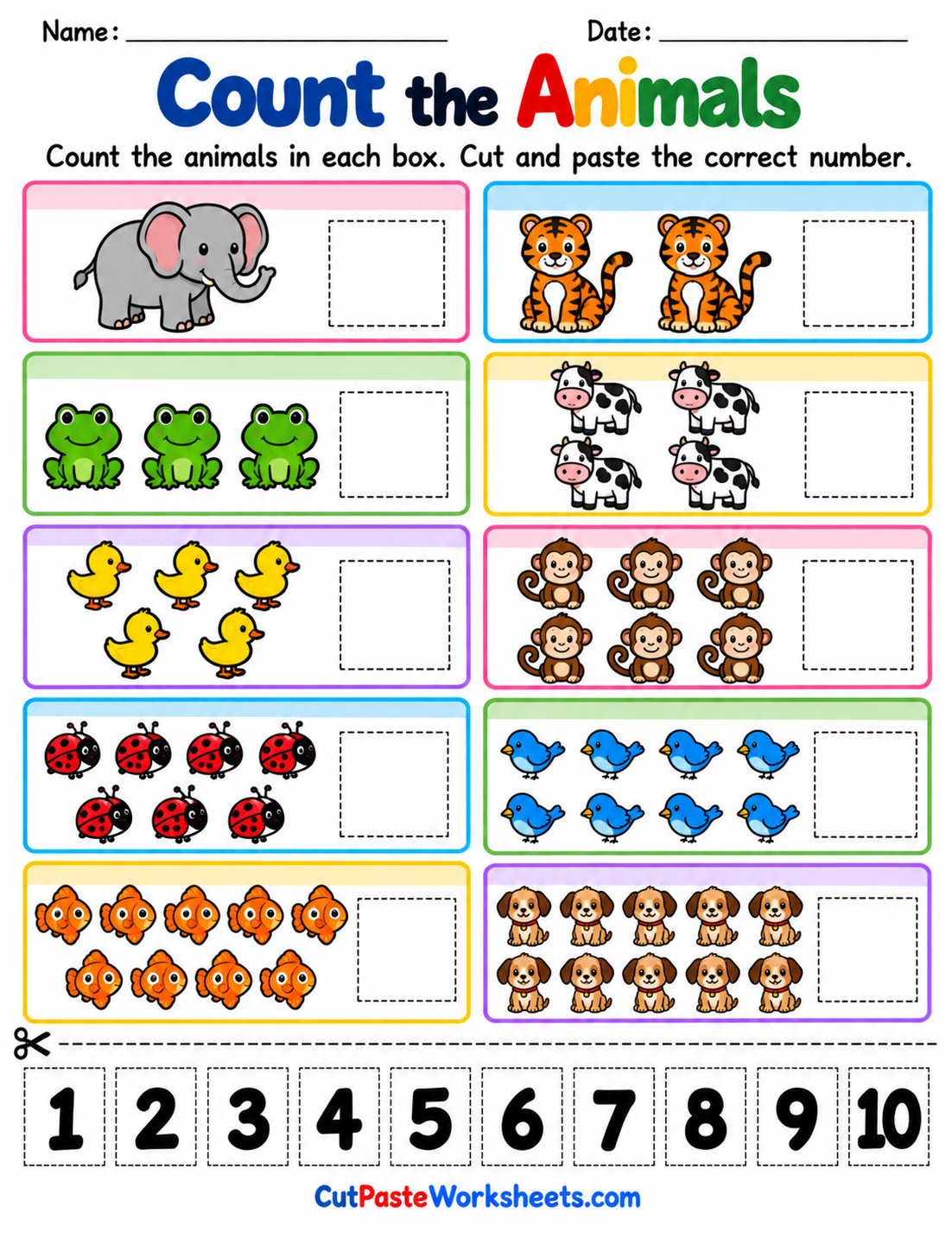
Count and Match Numbers 1–10
Practice matching quantities with numbers from 1 to 10.
↓ Download Worksheet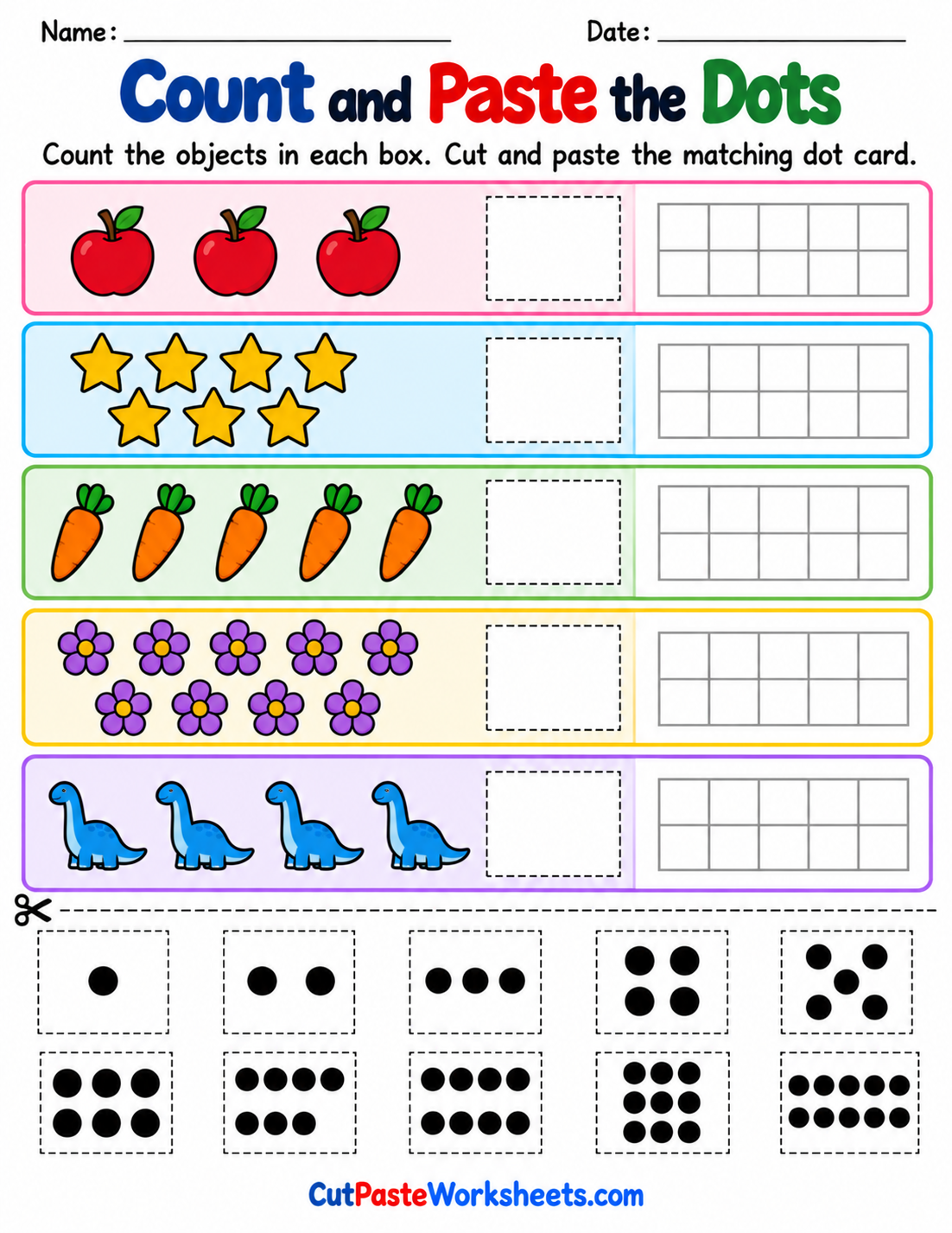
Count and Paste the Dots
Count colorful objects and match them with the correct dot cards.
↓ Download Worksheet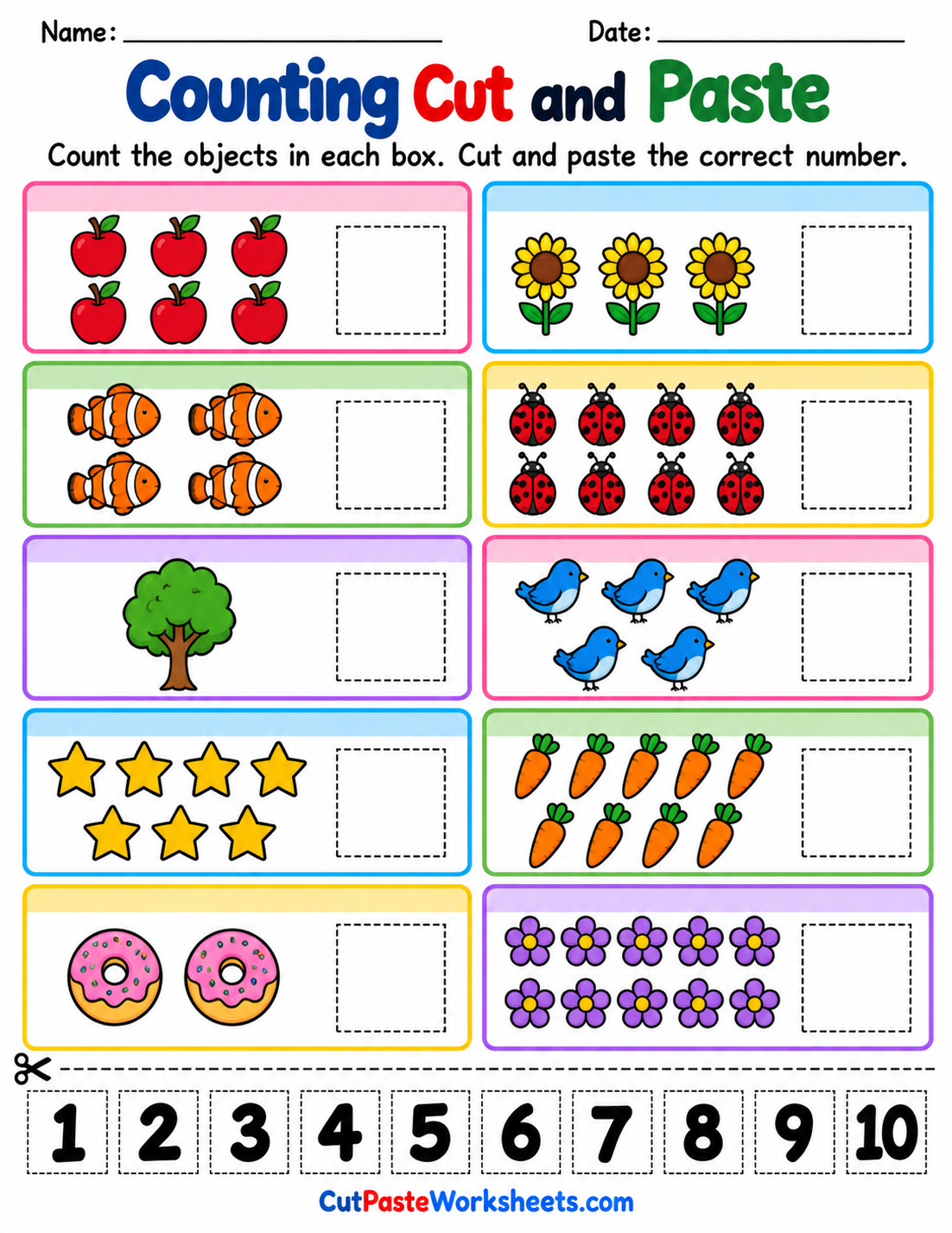
Count the Animals
Count different animals and paste the matching number.
↓ Download Worksheet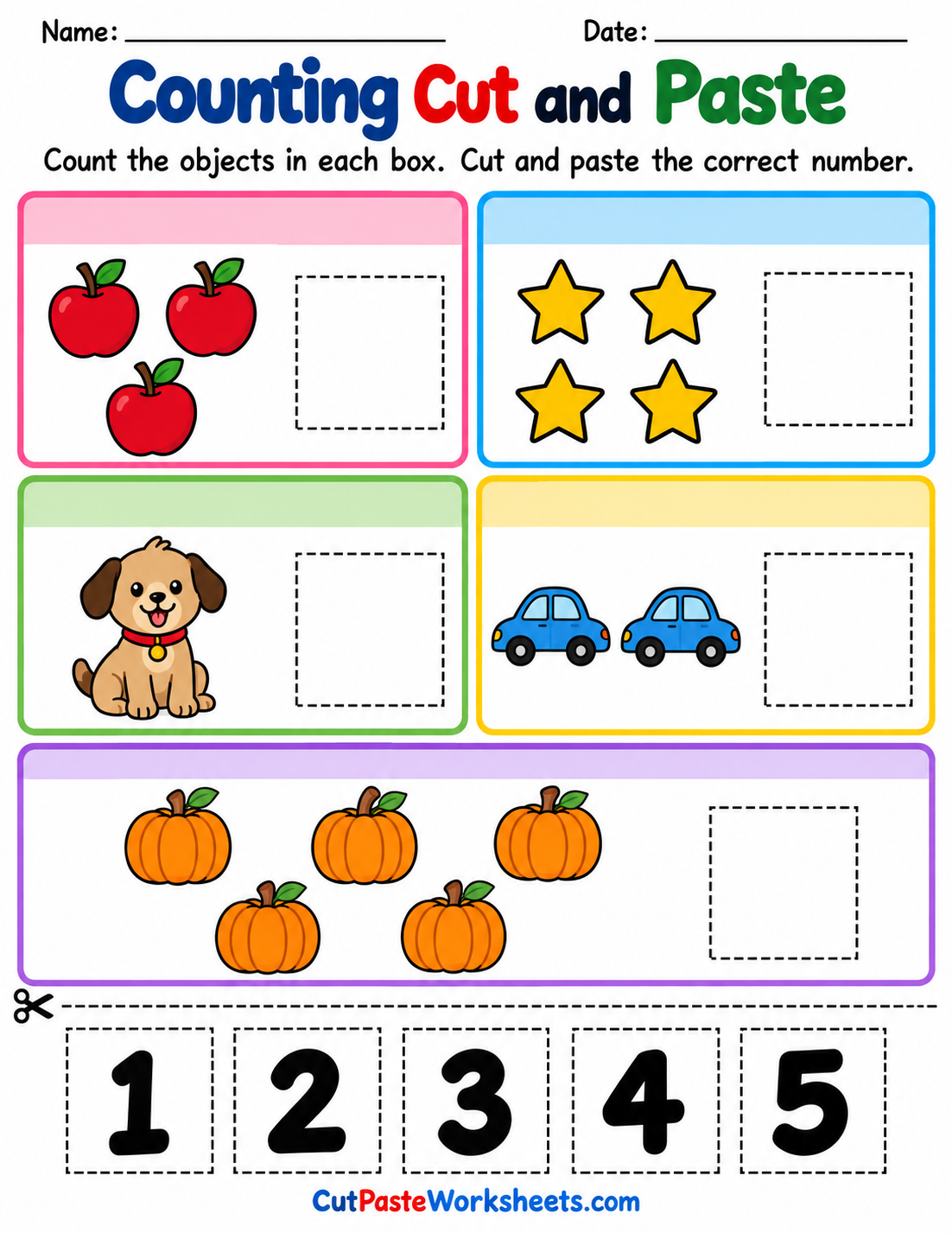
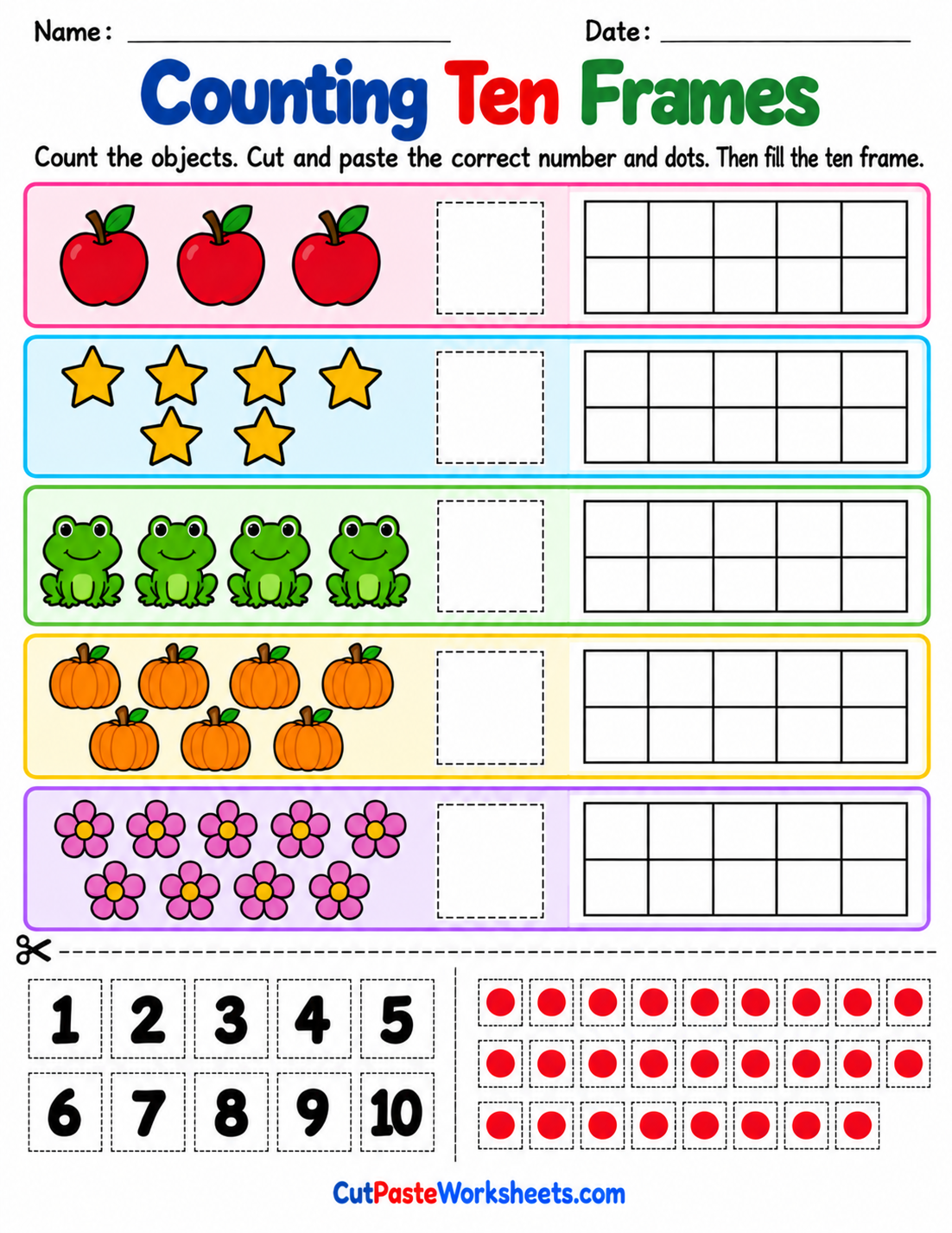
Counting Ten Frames
Count objects, paste the correct number, and complete ten frames using cutout dots.
↓ Download WorksheetWhat’s Included in These Counting Worksheets?
Our printable collection offers five activities that gradually introduce different ways to understand numbers and quantities.
1. Count and Match Numbers 1–5
This beginner-friendly worksheet introduces counting with familiar objects, including apples, stars, cars, and other colorful illustrations.
Children count the objects in each section and select the matching number from the cutout cards at the bottom of the page.
This activity is particularly helpful for preschoolers who are beginning to recognize numerals and understand that numbers represent quantities.
Skills practiced: Counting 1–5, number recognition, visual discrimination, and hand-eye coordination.
2. Count and Match Numbers 1–10
Once children become comfortable with smaller quantities, they can practice counting groups of up to ten objects.
The worksheet includes different collections of familiar pictures. Children carefully count each group before cutting out and pasting the corresponding numeral.
Teachers can encourage students to point to each object while counting aloud. This helps children avoid accidentally skipping or counting an object more than once.
Skills practiced: Counting 1–10, one-to-one correspondence, numeral recognition, and attention to detail.
3. Count and Paste the Dots
Recognizing quantities without relying entirely on written numbers is another important early math skill.
In this worksheet, children count groups of objects and identify dot cards that represent the same quantity.
Dot representations help students recognize that numbers can be shown in different ways, including pictures, numerals, and groups of dots.
For additional practice, children can describe how they counted the dots or compare two groups to determine which contains more.
Skills practiced: Quantity recognition, visual counting, number representation, and matching.
4. Count the Animals
Animal-themed activities are a fun way to keep young learners interested in counting practice.
This worksheet features colorful animal illustrations arranged in groups. Children count the animals and paste the correct numeral into the designated answer box.
Parents and teachers can extend the activity by asking questions such as, “How many frogs can you see?” or “Which group has more animals?”
These simple conversations encourage children to explain their thinking and develop early mathematical vocabulary.
Skills practiced: Counting animals, number matching, comparing quantities, and fine motor coordination.
5. Counting Ten Frames
Ten frames are commonly used in early mathematics education to help children visualize quantities from zero to ten.
A ten frame consists of two rows of five boxes. Children fill the boxes to represent a particular number, usually starting from the top-left corner and moving across each row.
In our counting ten frames worksheet, children count the illustrated objects, paste the matching number, and use cutout dots to fill the ten frame.
For example, if a group contains three apples, the child selects the number 3 and places three dots into the first three boxes.
This activity introduces children to number relationships and prepares them for addition and subtraction.
Skills practiced: Ten-frame representation, counting, number sense, and understanding quantities up to ten.
Benefits of Counting Cut and Paste Activities
Counting Cut and paste worksheets combine early math practice with hands-on learning. They offer several benefits for young children.
Develops Number Recognition
Children repeatedly see and work with numerals while completing each activity. Matching a written number with a group of objects helps strengthen the connection between numerical symbols and quantities.
Encourages One-to-One Correspondence
One-to-one correspondence means matching one counting word to one object.
For example, when counting four stars, children should point to each star once while saying “one, two, three, four.”
This foundational skill is essential for accurate counting and future mathematical development.
Supports Fine Motor Skills
Cutting along dashed lines, handling small paper pieces, and applying glue provide opportunities to practice fine motor coordination.
These movements help children develop hand control that is also useful for drawing, writing, and other classroom tasks.
Makes Learning More Interactive
Hands-on activities can make repetitive counting practice more engaging.
Children actively participate by observing, counting, selecting, cutting, and pasting rather than simply completing written exercises.
Provides Flexible Learning Opportunities
Printable counting worksheets can be used during independent practice, math centers, small-group instruction, or at-home learning sessions.
Teachers can also adjust the level of assistance according to each child’s abilities.
How to Use These Printable Counting Cut and Paste Worksheets
These activities require only a few basic materials: printed worksheets, child-safe scissors, and a glue stick.
Step 1: Print the worksheet. Download the desired activity and print it on US Letter paper (8.5 × 11 inches). Choose actual size or 100% scaling when available.
Step 2: Read the instructions. Explain the activity and demonstrate how to complete one example.
Step 3: Count the objects. Encourage children to point to each object while counting aloud.
Step 4: Cut out the pieces. Have children carefully cut along the dashed boundaries. Provide adult assistance when necessary.
Step 5: Match and paste. Children select the correct number or dot representation and glue it into the matching space.
Step 6: Review the answers. Count the objects together again to check each answer.
For ten-frame activities, children should also fill the correct number of boxes using the provided cutout dots.
Tips for Teachers and Parents
Children develop counting skills at different rates. Some may quickly recognize quantities up to ten, while others need additional practice with smaller numbers.
Start with the 1–5 counting worksheet before introducing activities involving larger quantities. Allow children to count aloud and use their fingers if needed.
For students who struggle with cutting, prepare the paper pieces beforehand so they can focus on counting and matching. As their confidence improves, gradually introduce more independent cutting practice.
Teachers can also laminate completed worksheets for classroom displays or use printed copies during small-group instruction.
To extend learning, ask children to find and count real objects around the classroom or home, such as pencils, blocks, crayons, or toy cars.
Connecting worksheet activities to everyday experiences helps children understand that counting is useful beyond the classroom.
Frequently Asked Questions
What age are counting cut and paste worksheets suitable for?
These worksheets are generally suitable for children ages 3–6, depending on their counting ability and fine motor development. Preschoolers may begin with numbers 1–5, while kindergarten students can practice quantities up to ten.
Are these counting worksheets free to download?
Yes. The counting worksheets on this page are available as free printables for educational use at home or in the classroom.
Can I use these worksheets in kindergarten math centers?
Yes. The activities work well for math centers, independent practice, small groups, and early-finisher activities. Teachers can select worksheets based on students’ current counting skills.
What is the purpose of a ten frame?
A ten frame helps children visualize numbers using a structured arrangement of ten boxes. It supports number recognition, counting, and understanding how quantities relate to five and ten.
Should children complete the worksheets in order?
It is helpful to begin with smaller quantities before moving to more challenging activities. However, teachers and parents can choose worksheets based on each child’s needs.
Make Counting Practice Fun and Meaningful
Learning to count becomes more meaningful when children can see, touch, and organize the quantities they are learning.
Our counting cut and paste worksheets provide a simple way to combine early number skills with engaging hands-on activities. Whether children are matching numbers, counting animals, or filling ten frames, each worksheet offers opportunities to strengthen their understanding of numbers.
Choose an individual worksheet from the printable collection above, or download the complete set for convenient classroom and home practice.